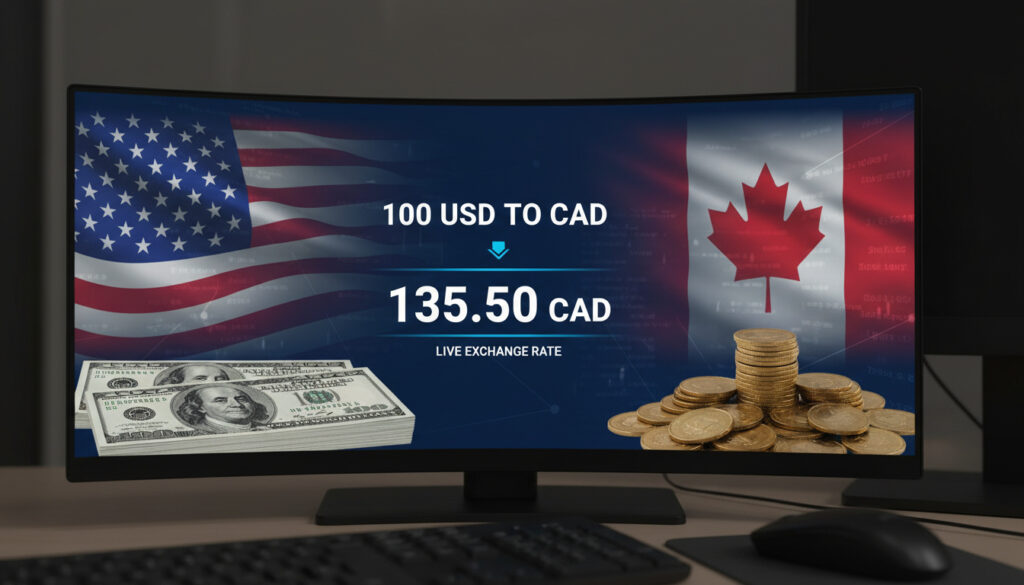
100 US to CAD – Live Exchange Rate and Converter Today
One hundred United States dollars currently converts to approximately 139.72 Canadian dollars at mid-market exchange rates observed in early April 2026. The USD/CAD pair has maintained relative stability near the 1.39 threshold following a volatile fourth quarter in 2025, when fluctuations between 1.36 and 1.41 tested both importers and travelers.
Currency markets continue to price the greenback at a significant premium against the loonie, a trend reinforced by divergent monetary policy expectations and commodity price movements. While retail consumers observe reference rates hovering between 1.387 and 1.393, the actual value received when converting physical currency often falls below these headline figures due to institutional spreads and service fees.
Understanding the precise mechanics behind this conversion requires examining both the wholesale interbank rates and the retail markup structures that determine how much Canadian currency actually lands in your account.
What is 100 USD to CAD Today?
| Current Mid-Market Rate 1.3918 CAD per USD |
24-Hour Change +0.20% As of April 1, 2026 |
| 180-Day Range 1.3584 – 1.4113 High/Low Spread |
100 USD Value 139.72 CAD Mid-market equivalent |
Key observations define the current currency landscape:
- The USD/CAD pair has stabilized near 1.39 following Q4 2025 volatility that saw swings between 1.36 and 1.41.
- One hundred American dollars purchases approximately 139.72 Canadian dollars at wholesale rates quoted by Revolut and interbank platforms.
- Retail bank rates typically reduce this value by 0.5% to 3%, yielding roughly 136 to 138 CAD for the same principal amount.
- December 2025 marked a recent peak at 1.4000, while July 2025 saw cyclical lows near 1.3584.
- The loonie remains sensitive to West Texas Intermediate crude oil benchmarks due to Canada’s energy export dependency.
- Monthly averages have ranged from 1.365178 (February 2026) to 1.40505 (November 2025) according to OFX historical data.
| Metric | Value |
|---|---|
| 100 USD Equals (Mid-Market) | 139.72 CAD |
| Spot Rate (April 1, 2026) | 1.3918 CAD per USD |
| Daily High | 1.3934 |
| Daily Low | 1.3874 |
| 24-Hour Percentage Change | +0.20% |
| March 2026 Monthly Average | 1.372518 |
| 52-Week High (180-day max) | 1.4113 |
| 52-Week Low (180-day min) | 1.3584 |
| Yearly Average (2025-2026) | 1.383128 |
| Estimated Bank Retail Rate | 1.36 – 1.38 (136-138 CAD per 100 USD) |
What is the Current USD to CAD Exchange Rate?
Mid-Market Benchmarks
Foreign exchange data providers confirm the pair hovers near 1.391. Xe charts display live fluctuations around 1.39114, while Wise historical data tracks similar levels at 1.39175. TradingView technical indicators show a 0.20% rise over the immediate 24-hour window, reflecting continued dollar strength against the Canadian currency.
Mid-market rates represent the midpoint between global buy and sell prices for currency pairs. These wholesale benchmarks exclude retail markups and service fees. Financial institutions typically apply spreads of 0.5% to 3% above these levels, meaning consumers rarely receive the 1.3918 rate shown on currency converter widgets.
Official Reference Rates
The Bank of Canada publishes daily exchange rates based on noon valuations from major trading banks. While these official rates align closely with interbank levels near 1.39, they serve as reference points rather than executable transaction prices. Retail consumers accessing rates through commercial banks encounter additional layers of pricing that incorporate operational costs and profit margins.
How to Convert USD to CAD?
Digital Conversion Platforms
Online services like Xe, Wise, and Revolut provide real-time conversion calculators that refresh continuously during market hours. These platforms display mid-market rates for informational purposes, though actual transfer rates may include platform-specific fees. When planning purchases in Canada, such as dining at Shaker Cuisine et Mixologie Repentigny – Menu, Hours & Reviews, checking these digital benchmarks helps establish baseline budgeting before accounting for card fees or cash exchange markups.
Bank and Wire Transfers
Traditional banking channels offer wire transfer services and foreign exchange desks, though typically at less favorable rates than digital specialists. Bank customers converting 100 USD might receive between 136 and 138 CAD depending on their institution’s specific spread and fee structure. Currency exchange bureaus in airports and tourist centers often apply the widest margins, frequently exceeding 3% above mid-market levels.
What Affects the USD/CAD Exchange Rate?
Petroleum Market Correlation
The Canadian dollar maintains a historically positive correlation with crude oil prices. As one of the largest energy exporters globally, Canada’s currency typically strengthens when West Texas Intermediate benchmarks rise, and weakens during oil slumps. This relationship explains why OFX data shows sustained pressure on the loonie during periods of commodity price uncertainty.
Because approximately 20% of Canadian exports consist of energy products, the loonie functions as a petrocurrency. When oil prices decline, Canada’s trade balance weakens, reducing demand for CAD and pushing the USD/CAD rate higher. Conversely, energy rallies typically support the Canadian dollar, lowering the cost of converting American dollars northward.
Monetary Policy Divergence
Interest rate decisions from the U.S. Federal Reserve and the Bank of Canada directly impact relative currency valuations. Recent stability near 1.39 reflects aligned policy expectations following the volatility of 2025, though any divergence in inflation targeting or rate trajectories could quickly shift the pair toward the 1.37 or 1.40 boundaries observed in recent months.
Daily fluctuations of 0.001 to 0.01 CAD are common between market open and close. ExchangeRates.org.uk documented a 0.006 range on March 31, 2026 alone, with the pair touching 1.3912 at close after reaching 1.3934 intraday. Transactions involving large sums should consider limit orders or rate alerts to avoid adverse movements.
Inflation Data and CPI Events
Consumer Price Index releases from both nations drive immediate rate reactions as traders adjust expectations for central bank responses. Investing.com historical data shows daily changes ranging from -0.20% to +0.50% following significant inflation surprises, with the USD generally strengthening against CAD when U.S. inflation exceeds Canadian levels.
USD to CAD Historical Timeline for 100 USD
- : 100 USD equaled approximately 135.84 CAD at the 180-day low of 1.3584.
- : Monthly average reached 1.39949, valuing 100 USD at roughly 139.95 CAD.
- : The average climbed to 1.40505, pushing 100 USD to approximately 140.51 CAD.
- : Peak rate hit 1.4000 exactly, marking 140.00 CAD per 100 USD.
- : Holiday liquidity drove the rate down to 1.3670, yielding 136.70 CAD.
- : Monthly average settled at 1.377931, converting 100 USD to approximately 137.79 CAD.
- : The rate softened to a 1.365178 average, dropping 100 USD to roughly 136.52 CAD.
- : Recovery brought the average to 1.372518, valuing 100 USD at approximately 137.25 CAD.
- : Current trading range between 1.3874 and 1.3934 places 100 USD at approximately 138.74 to 139.34 CAD.
Live Rate vs Bank/Transfer Rates
| Established Information | Variables and Uncertainties |
|---|---|
| Mid-market rate consistently near 1.3918 CAD per USD | Exact retail bank rates vary by institution (0.5-3% markup) |
| 100 USD = 139.72 CAD at wholesale interbank levels | Real-time transaction fees depend on service tier and volume |
| Daily high/low spreads documented by historical archives | Future Federal Reserve and Bank of Canada policy decisions |
| 180-day range confirmed between 1.3584 and 1.4113 | Specific CPI release impacts and oil price shocks |
| Volatility averages 0.001-0.01 CAD daily | Exact timing of breakouts above 1.40 or drops to 1.37 |
Why USD/CAD Fluctuates: Economic Context
The exchange rate between American and Canadian dollars reflects deep structural economic ties alongside divergent growth trajectories. Canada’s status as a major commodity exporter creates inherent volatility, as the currency adjusts to global demand for natural resources. When energy prices stabilize or climb, the loonie typically strengthens, making Canadian goods and services—such as home improvement products found in guides like Hot Tub Covers Canada – Best Picks, Prices and Buyer’s Guide—more expensive for American buyers.
Trade balance differentials further influence the pair. The United States maintains a persistent trade deficit with Canada in goods, though services balances partially offset this flow. Currency movements act as natural correctors for these imbalances, with a stronger USD encouraging American tourism and imports from Canada while dampening Canadian demand for U.S. exports.
Interest rate spreads between the Federal Reserve and the Bank of Canada drive capital flows that directly impact the exchange rate. As of early 2026, relative stability near 1.39 suggests markets have priced in similar policy trajectories, though any divergence in inflation management could swiftly test the recent trading range.
Expert Sources & Official Data
Market data providers confirm the current stability within the 1.36-1.41 channel observed since mid-2025. IFCM market data recorded the April 1, 2026 rate at 1.39031, while multi-source charts from Xe and TradingView cluster near 1.3918.
“USD/CAD hovering 1.36-1.41 since mid-2025, with volatility concentrated in Q4 2025 during the shift from summer lows near 1.36 to December peaks near 1.40.”
— Aggregated market data from TradingView and Xe
Historical context provided by OFX demonstrates the yearly average settling at 1.383128 across the 2025-2026 period, with monthly breakdowns showing November 2025 as the strongest recent month for the greenback and February 2026 as the weakest.
What’s Next for USD/CAD?
Currency strategists anticipate short-term stability around the 1.39 level, with directional breaks contingent upon upcoming inflation reports and central bank policy signals. Technical levels to watch include resistance near 1.40 and support at 1.37, boundaries that have contained price action since mid-2025. For consumers planning cross-border purchases or travel, monitoring real-time converters provides essential budgeting clarity, whether calculating meal costs at Canadian restaurants or comparing outdoor living expenses using resources like Hot Tub Covers Canada – Best Picks, Prices and Buyer’s Guide.
Frequently Asked Questions
Is 100 USD more or less than 100 CAD?
One hundred USD is significantly more than 100 CAD. At current exchange rates near 1.39, 100 USD equals approximately 139.72 CAD at mid-market rates.
What is the Bank of Canada USD rate?
The Bank of Canada publishes official daily exchange rates based on noon valuations from major trading banks. These typically reflect wholesale interbank levels near 1.39 but exclude retail markups and service fees.
How much is 100 US dollars in Canadian dollars at a bank?
At retail banks, 100 USD typically converts to between 136 and 138 CAD, representing a 0.5% to 3% markup below the mid-market rate of approximately 139.72 CAD.
Why do different websites show different USD to CAD rates?
Variations reflect timing, as rates update continuously during market hours, and source methodology. Mid-market platforms like Xe and Wise show wholesale benchmarks near 1.391, while bank portals include spreads. Historical tracking sites may display slight delays.
Does the USD to CAD rate change daily?
Yes. The rate fluctuates constantly during forex market hours. Daily ranges of 0.001 to 0.01 CAD are common, with recent data showing movements of ±0.20% to 0.50% within 24-hour periods.
Is it better to convert USD to CAD in the US or Canada?
Generally, converting within Canada often yields better rates for USD to CAD transactions due to higher competition among exchange services, though digital platforms like Wise and Revolut offer superior rates regardless of physical location.
More related posts
 CPP and OAS Payment October 2025: Dates, Amounts & Increases
 Kelly Clarkson Weight Loss – How She Lost 60 Lbs in 2024
 USD to CAD Rate Today: Current Exchange Rate & Forecast (2025)
 Russian Kotleti Near Me – Local Spots, Authentic Recipe Guide
 Ian Harding: Wife, Lupus, and Life After Pretty Little Liars
 Bill Hader Movie and TV Show : Complete Filmography Li t
 Maple Leafs vs Senators Tickets – Prices, Sites and Schedule
 Is Trump a Republican? Party Affiliation and History Explained