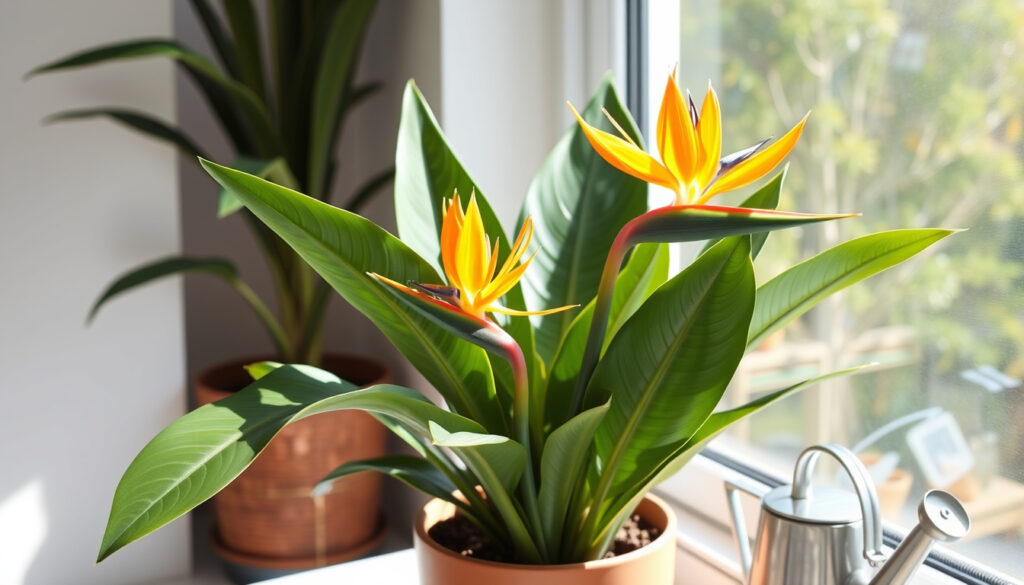
Bird of Paradise Plant Care: Complete Indoor Guide
Anyone who has brought home a Bird of Paradise plant knows the feeling: those huge, paddle-shaped leaves seem to promise jungles and sunshine, yet the reality is often a north-facing flat in Dublin or Cork. The trick is that Strelitzia does not demand a tropical greenhouse—with the right light and humidity management, this South African native can feel perfectly at home in an Irish sitting room, and with proper care, it may even reward you with its iconic orange-and-blue bloom.
Native region: South Africa ·
Species in genus: 5 (Strelitzia) ·
Indoor height range: 3–6 ft (0.9–1.8 m) ·
USDA hardiness zone (outdoor): 10–12 ·
Toxicity to pets: Mildly toxic if ingested
Quick snapshot
- Bird of Paradise belongs to the genus Strelitzia, native to South Africa (Plant Store IE)
- Bright indirect light is essential for healthy growth (Gardenia.net (horticultural guide))
- Exact indoor bloom frequency depends on light, age, and variety — science is anecdotal (Gardeners’ World (UK gardening authority))
- Optimal soil pH range is broad (5.5–7.0); precise needs vary by cultivar (Gardenia.net (horticultural guide))
- 1773: Strelitzia reginae first described by Joseph Banks
- 1855: Strelitzia nicolai introduced to European horticulture
- 1960s–present: Grows in popularity as a houseplant, especially in temperate regions
- Focus on humidity management as central heating dries indoor air in winter (The Little Botanical (UK plant retailer))
- Expect first blooms after 3–5 years of maturity with adequate light (Gardeners’ World (UK gardening authority))
The table below compiles the essential specifications for Bird of Paradise care.
| Attribute | Value |
|---|---|
| Botanical name | Strelitzia spp. (typically S. reginae or S. nicolai) |
| Family | Strelitziaceae |
| Native to | South Africa (Plant Store IE (Irish plant specialist)) |
| Mature indoor height | 3–6 ft (0.9–1.8 m) |
| Mature outdoor height | Up to 30 ft (9 m) for S. nicolai |
| Flower color | Orange and blue (S. reginae); white and blue (S. nicolai) |
| USDA hardiness zones | 10–12 |
| Pet toxicity | Mildly toxic (stomach upset if ingested) (Gardeners’ World (UK gardening authority)) |
Is Bird of Paradise a good indoor plant?
Why Bird of Paradise thrives indoors
- It adapts well to indoor conditions with proper care, making it a reliable houseplant for temperate climates (Gardenia.net (horticultural guide))
- Indoor plants typically reach 3–6 ft (0.9–1.8 m) tall, fitting standard ceiling heights
- Leaves can grow up to 2 m tall, so it needs space in a south-facing room or conservatory (Gardeners’ World (UK gardening authority))
The catch: Bird of Paradise is a bold choice for indoor living, but it demands commitment — especially on light and humidity.
Varieties best suited for indoor growing
- Strelitzia reginae is the most common indoor variety, with orange-and-blue flowers (Plant Store IE (Irish plant specialist))
- Strelitzia nicolai (white Bird of Paradise) grows taller and has larger leaves, better for spacious rooms (The Little Botanical (UK plant retailer))
The implication: Choose S. reginae for a manageable size, S. nicolai if you have room for a statement plant.
Bird of Paradise offers dramatic foliage and the potential for blooms indoors, but Irish growers face the paradox: limited winter light meets a plant that craves brightness. The solution is window placement, not artificial lights.
The implication: For Irish homes, the Bird of Paradise remains a viable option if you can meet its light and humidity needs.
Does Bird of Paradise need full sun?
Indoor light requirements for Bird of Paradise
- Bright, indirect light is ideal — a south- or west-facing window works best (Gardenia.net (horticultural guide))
- Direct sun for 4+ hours encourages flowering in mature plants
- Shield young plants from midday sun to prevent leaf scorch
Signs of too much or too little light
- Leaves scorch in prolonged direct afternoon sun — brown patches appear on the leaf surface (Gardeners’ World (UK gardening authority))
- Leggy growth and lack of new leaves signal insufficient light
- Leaves may curl or droop if light levels are too low (Plant Store IE (Irish plant specialist))
Why this matters: In Ireland, winter daylight is short and often grey. Even a south-facing window may not deliver enough light for flowering. If leaves stop growing, consider moving the plant closer to the glass.
How do I look after a Bird of Paradise plant?
Watering schedule for Bird of Paradise
- Water when the top 2–3 inches (5–7 cm) of soil are dry — every 1–2 weeks in summer, less in winter (Plant Store IE (Irish plant specialist))
- Use filtered or overnight-settled water to avoid mineral buildup
- Reduce watering in winter when growth slows (Gardeners’ World (UK gardening authority))
Humidity and temperature needs
- Prefers 40–60% humidity — mist leaves weekly or use a pebble tray (Gardenia.net (horticultural guide))
- Temperatures between 18–27°C are ideal; avoid drafts and sudden drops (Plant Store IE (Irish plant specialist))
- Keep away from air conditioning vents and cold windows in winter (Gardeners’ World (UK gardening authority))
Soil and repotting guide
- Use well-draining potting mix — a 3:1 ratio of soil-based compost (e.g., John Innes No. 3) to grit (Gardeners’ World (UK gardening authority))
- Add perlite or orchid bark for extra drainage
- Repot every 2–3 years in spring; crowded roots can slow growth (House Plant House (plant care blog))
Fertilizer routine
- Feed monthly in spring and summer with a balanced 10-10-10 liquid fertilizer (Plant Store IE (Irish plant specialist))
- For more frequent feeding: every two weeks from April to September with liquid houseplant feed (Gardeners’ World (UK gardening authority))
- Reduce or stop fertilizing in fall and winter when growth naturally slows
The pattern: Bird of Paradise care is about rhythm — water when dry, feed when growing, and maintain humidity year-round.
The pattern: Consistent care routines are more important than exotic conditions.
What are common mistakes in Bird of Paradise care?
Overwatering and root rot
- Overwatering is the most frequent issue — yellowing leaves and mushy stems signal trouble (Gardeners’ World (UK gardening authority))
- Let the top few centimeters of soil dry out between waterings to prevent root rot
Low humidity causing leaf browning
- Brown leaf edges often indicate low humidity — especially in winter with central heating (Gardenia.net (horticultural guide))
- Mist daily in winter or use a humidifier near the plant (The Little Botanical (UK plant retailer))
Insufficient light preventing blooms
- Flowering requires bright light and maturity — first blooms appear after 3–5 years (Gardeners’ World (UK gardening authority))
- Without enough light, the plant will survive but rarely flower indoors
Using the wrong pot size
- Crowded roots can reduce growth, but root restriction in pots can encourage blooming (House Plant House (plant care blog))
- Repot when roots emerge from drainage holes, but only go up one pot size
What this means: The two biggest threats to your Bird of Paradise in an Irish home are overwatering (easy to do in cool, dark months) and dry air from central heating. Fix those two, and your plant will likely thrive.
Where is the best place to put a Bird of Paradise?
Best window orientation
- South- or west-facing windows are optimal for bright, indirect light (Gardenia.net (horticultural guide))
- East-facing windows work but may not provide enough light for flowering
- North-facing windows are generally too dim — growth will be slow (Plant Store IE (Irish plant specialist))
Avoiding drafts and heat sources
- Avoid cold drafts from windows and doors, especially in winter (Gardeners’ World (UK gardening authority))
- Keep away from air conditioning vents and direct radiator heat
Outdoor placement in mild climates
- In USDA zones 10–12, full sun to partial shade outdoors is ideal (Gardenia.net (horticultural guide))
- In Ireland, summer outdoor placement in a sunny spot is possible, but return indoors by early autumn before temperatures fall below 10°C (Gardeners’ World (UK gardening authority))
The catch: An Irish summer is short. If you move your Bird of Paradise outdoors, do it gradually — and don’t forget to bring it back in before October. For a cohesive interior, consider pairing your plant with Mid Century Modern Furniture: 2026 Guide for Irish Buyers.
What is the lifespan of a Bird of Paradise plant?
Indoor lifespan with proper care
- Indoor plants can live 10–20 years or more with consistent care (Plant Store IE (Irish plant specialist))
- Regular leaf cleaning (wipe dust off) helps photosynthesis and reduces pest risk (House Plant House (plant care blog))
How long flowers last
- Individual flowers last about 2 weeks on the plant (Gardeners’ World (UK gardening authority))
- Cut flowers can last up to 2 weeks in a vase if harvested properly
When to expect first blooms
- First blooms occur after 3–5 years of maturity (Gardeners’ World (UK gardening authority))
- Flowering indoors is not guaranteed; it depends heavily on light levels and root restriction
Why this matters: A Bird of Paradise is not a short-term houseplant. It’s a decade-long investment. For Irish growers, the reward of a first bloom after 4–5 years makes the waiting worth it — but only if you provide enough light. Pair its sculptural foliage with Benjamin Moore Revere Pewter HC-172: Guide to Greige for a calming interior palette.
Upsides
- Dramatic foliage brings instant tropical feel to any room
- Long-lived — 10–20 years with proper care
- Relatively pest-resistant compared to other tropical houseplants
- Can flower indoors with adequate light and maturity
Downsides
- Needs bright light — challenging in winter in Ireland
- Requires consistent humidity, especially with central heating
- Can reach 2 m tall, demanding floor space
- Mildly toxic to cats and dogs if ingested (Gardeners’ World (UK gardening authority))
Steps to repotting a Bird of Paradise
- Choose a pot 2–3 inches wider than the current one with drainage holes.
- Prepare a well-draining mix: 3 parts soil-based compost (e.g., John Innes No. 3) to 1 part grit or perlite (Gardeners’ World (UK gardening authority))
- Remove the plant carefully from its current pot — protect the flower sheath (spathe) if present (House Plant House (plant care blog))
- Place a layer of fresh mix in the new pot, position the plant, and fill around it.
- Water thoroughly and place in bright indirect light.
- Wait 4–6 weeks before fertilizing to avoid root burn.
Bird of paradise plants are sensitive to low temperatures, and tend to like it a little warmer and humid. — IKEA UK plant care guide (Gardeners’ World (UK gardening authority))
Bird of Paradise are beautiful plants that do really well indoors, provided they get enough light. — Costa Farms nursery (Gardenia.net (horticultural guide))
For the Irish plant owner, the decision is clear: place your Bird of Paradise in the brightest room you have, water sparingly, and accept that flowering is a bonus, not a guarantee. The plant’s lush foliage alone makes it a worthy companion for a decade or more.
For a deeper dive into common issues, check out this complete care and troubleshooting guide from another expert source.
Frequently asked questions
Can Bird of Paradise grow in low light?
It can survive in low light but will grow very slowly and rarely flower. Bright indirect light from a south or west window is strongly recommended (Gardenia.net (horticultural guide)).
How do I fix brown leaf edges on my Bird of Paradise?
Brown leaf edges typically indicate low humidity or mineral buildup from tap water. Increase humidity by misting daily, use filtered water, and trim the brown edges with clean scissors (Gardenia.net (horticultural guide)).
Should I mist my Bird of Paradise daily?
Misting daily in winter helps combat dry indoor air from central heating. In summer, misting a few times a week is sufficient. A pebble tray or humidifier works as well (The Little Botanical (UK plant retailer)).
Why are my Bird of Paradise leaves splitting?
Leaf splitting is natural — the plant’s large leaves are designed to split to allow wind and light to pass through. It is not a sign of poor health. However, excessive splitting may indicate low humidity or physical damage (Gardeners’ World (UK gardening authority)).
How often should I repot a Bird of Paradise?
Every 2–3 years in spring. Use a pot only 2–3 inches larger than the current one. Root restriction may encourage blooming, so avoid oversized pots (House Plant House (plant care blog)).
Can I keep Bird of Paradise in a bedroom?
Yes, if the bedroom has a south- or west-facing window. Bedrooms are often cooler, which is fine as long as temperatures stay above 10°C. The plant may need extra humidity in winter (Plant Store IE (Irish plant specialist)).
What does an overwatered Bird of Paradise look like?
Yellowing lower leaves, mushy stems, and a foul smell from the soil indicate root rot. Stop watering immediately and check the roots. Trim any rotten roots and repot in fresh dry mix (Gardeners’ World (UK gardening authority)).
For Irish households considering a Bird of Paradise, the choice is clear: this plant asks for bright light, consistent humidity, and patience. In return, it offers a lifetime of sculptural foliage and the occasional, breathtaking flower. The room you place it in becomes defined by its presence.
More related posts
 16000 USD to CAD – Current Rate and Conversion Guide
 Is Trump a Republican? Party Affiliation and History Explained
 How to Make Whipped Coffee (Dalgona) – Easy 3-Ingredient Recipe
 David Lynch Cause of Death and Life Legacy
 La Vie Est Belle Perfume: Meaning, Scent & Celebrity Fans
 House of the Rising Sun: Origins, Versions, Lyrics & Chords
 Lars and the Real Girl: Mental Disorder & Movie Analysis
 Murder She Wrote 2025: Confirmed Facts and Where to Watch