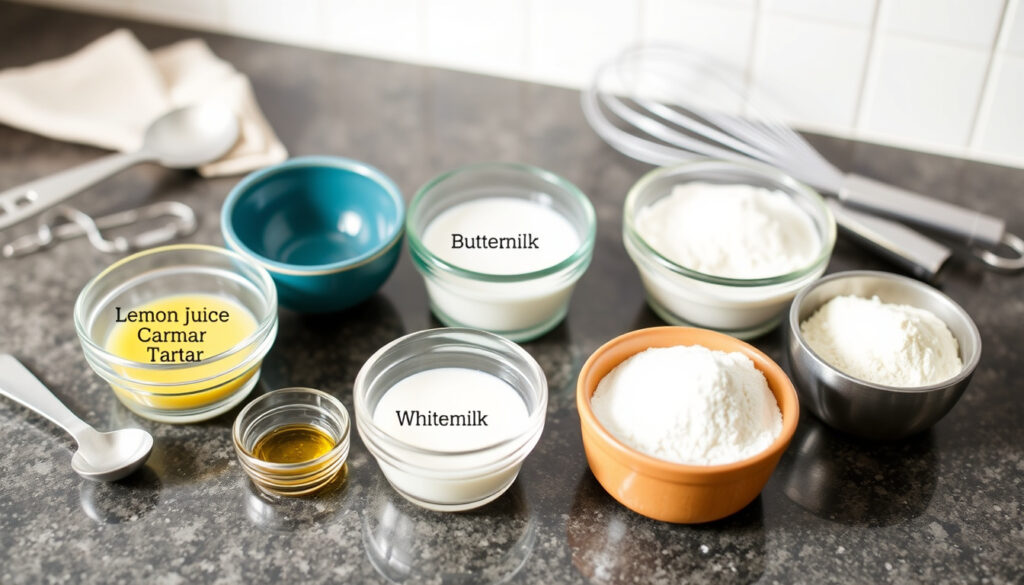
Cream of Tartar Substitute: 6 Best Alternatives for Baking
You’re halfway through mixing a batch of snickerdoodles when you reach for the cream of tartar — and the jar is empty. A handful of common kitchen ingredients, from lemon juice to plain yogurt, can step in without ruining your recipe.
Chemical composition: Potassium bitartrate ·
Primary function: Acidifier and stabilizer ·
Common substitute ratio (lemon juice): 2:1
Quick snapshot
- Cream of tartar is potassium bitartrate (Healthline (nutrition resource))
- Lemon juice and white vinegar direct-substitute for acidity (Healthline (nutrition resource))
- Baking powder contains cream of tartar (Healthline (nutrition resource))
- Whether substitutes alter final taste equally in all recipes
- Exact substitution ratio for buttermilk in dry versus wet recipes
- June 2024: The Semi Sweet Sisters published tested snickerdoodle recipe without cream of tartar (The Semi Sweet Sisters (baking blog))
- More home bakers sharing tested ratios for vinegar and lemon juice in cookies and meringues
Cream of tartar is a pH-adjuster in your pantry: its unique acidity stabilizes egg whites and prevents sugar crystals from forming. When you substitute, you’re really answering one question: does this recipe need the acidity, the leavening, or both? Get that right, and the swap works every time.
What is cream of tartar?
Cream of tartar is the powdered crystalline acid known chemically as potassium bitartrate. It forms naturally inside wine barrels during fermentation and is collected as a sediment, then refined into the fine white powder sold in spice aisles today. According to Healthline (nutrition resource), it can function as a leavening agent, help stabilize whipped egg whites, and reduce sugar crystallization in icings and candies.
How is cream of tartar made?
- During winemaking, tartaric acid in grape juice reacts with potassium to form potassium bitartrate crystals.
- These crystals — called “wine diamonds” — settle on barrel walls and are scraped off, purified, and ground into powder.
- The process is almost exclusively a byproduct of the wine industry, not a manufactured synthetic product.
The trade-off: its scarcity at home means bakers often need a substitute mid-recipe, not as a planned swap. Understanding its origin clarifies why acid-based replacements work.
What is cream of tartar chemically?
Potassium bitartrate (KC4H5O6) is a natural acid salt. When mixed with water, it releases hydrogen ions — that’s the acidic punch that reacts with baking soda to produce carbon dioxide bubbles. It also lowers the pH of egg whites, making the proteins bond more tightly and creating a stable foam. As Vanilla Bean Cuisine (baking resource) notes, cream of tartar is both a leavening agent and a contributor of slight tangy flavor in baked goods.
Because cream of tartar is purely acidic, you cannot swap it with baking soda (a base) without adding another acid. A common mistake: replacing cream of tartar with baking soda alone creates a chemical mismatch that leaves baked goods flat and soapy-tasting.
What can I use if I don’t have cream of tartar?
How much lemon juice replaces cream of tartar?
For stabilizing egg whites or preventing sugar crystallization, Healthline (nutrition resource) recommends substituting equal amounts of lemon juice for cream of tartar. That means 1 teaspoon of lemon juice for every 1 teaspoon of cream of tartar called for. In baking recipes where acidity and leavening are both needed, the ratio shifts to 2 parts lemon juice for 1 part cream of tartar, since you need extra liquid to compensate for the missing dry powder.
Vanilla Bean Cuisine’s snickerdoodle recipe without cream of tartar uses 2 teaspoons of lemon juice in the cookie batter alongside 1/4 teaspoon of baking soda to achieve the same chewy, slightly tangy result.
Can I use white vinegar as a substitute?
White vinegar works at identical ratios to lemon juice. Use 1 teaspoon of distilled white vinegar per 1 teaspoon of cream of tartar for stabilizing eggs or preventing crystallization. For baking recipes, use 2 teaspoons per 1 teaspoon of cream of tartar. The Semi Sweet Sisters tested lemon juice, vinegar, and baking powder as cream of tartar replacements in snickerdoodles and found distilled white vinegar was its favorite substitute in the recipe.
What about buttermilk or yogurt?
For recipes that use baking soda as their primary leavener (pancakes, cakes, biscuits), you can replace 1/4 teaspoon of cream of tartar with 1/4 cup of buttermilk or plain yogurt — but you must reduce another liquid in the recipe by the same amount. These dairy substitutes add acidity plus moisture, which works well for batter-based baked goods. However, they won’t work for stabilizing egg whites or preventing crystallization in icings because they introduce fat and protein that interfere with those processes.
The choice between lemon juice, vinegar, and buttermilk depends entirely on the recipe’s function: dry-acid for meringues and icings, wet-acid for batters. Using buttermilk in a meringue would deflate the foam. Using vinegar in buttermilk pancakes would miss the fat and moisture that structure requires. Match the substitute to the recipe’s primary need, not just to acidity alone.
Is cream of tartar really necessary?
What happens if I skip cream of tartar in cookies?
In snickerdoodles, cream of tartar does two things: it reacts with baking soda to produce a light, chewy texture, and it gives the cookies their signature tangy flavor. According to Vanilla Bean Cuisine, the texture of its snickerdoodles remained soft and chewy when using baking soda plus lemon juice instead of cream of tartar. Without any substitute, the cookies would turn out denser, flatter, and lacking that characteristic tang.
Can I omit cream of tartar from meringue?
Skipping cream of tartar from meringue is riskier. Healthline explains that cream of tartar helps stabilize whipped egg whites and prevent weeping — the thin liquid that sometimes seeps out of baked meringues. Without it, your egg whites may take longer to whip, reach less volume, and collapse more easily in the oven. For best results, use lemon juice or white vinegar at a 1:1 ratio.
Healthline explains that cream of tartar helps stabilize whipped egg whites and prevent weeping — the thin liquid that sometimes seeps out of baked meringues.
Cream of tartar is often labeled as optional in cookie recipes but nearly essential in meringue. The distinction comes down to structure: cookies get their stability from flour and butter, while meringue has nothing but egg proteins and air. Skipping the acid in meringue means skipping structural reinforcement — and that’s a gamble most bakers shouldn’t take.
The pattern: the more structural support the recipe has, the more forgiving skipping cream of tartar becomes. Cookies with flour, butter, and sugar are robust; meringue with only egg whites and sugar is fragile. Always substitute in fragile recipes; you can sometimes skip in robust ones.
Is cream of tartar just baking soda?
What is the difference between cream of tartar and baking soda?
This is a common confusion because the two are often paired. Cream of tartar is an acid (potassium bitartrate); baking soda is a base (sodium bicarbonate). They are chemically opposite. When combined with moisture and heat, they react to produce carbon dioxide — the bubbles that make baked goods rise. Healthline notes that they are not interchangeable; together they form a complete leavening agent.
Can I use baking soda instead of cream of tartar?
No — not without adding an acid. Replacing cream of tartar with baking soda alone produces a base-heavy mixture that will taste soapy and fail to leaven properly. If the recipe already contains an acidic ingredient such as buttermilk, yogurt, or cocoa, you may be able to skip the cream of tartar and use a little less baking soda, but the balance is delicate. The safest approach is to use baking powder, which contains both cream of tartar and baking soda in a pre-balanced ratio.
Here is a direct comparison of their chemical properties and functions.
| Property | Cream of tartar | Baking soda |
|---|---|---|
| Chemical name | Potassium bitartrate | Sodium bicarbonate |
| pH | Acidic (pH ~3.5) | Basic (pH ~8.4) |
| Primary function | Stabilizer, acidifier, crystallization blocker | Leavening (produces CO2 with acid + heat) |
| Interaction with heat alone | No gas production | Releases CO2 at >80°C |
| Can substitute for the other? | No — needs additional acid | No — needs additional base |
Key takeaway: 3 distinct properties, one pattern — cream of tartar provides the acid, baking soda provides the base, and only when both are present do you get reliable leavening. Swapping one for the other without rebalancing the recipe chemistry guarantees a failed bake.
Lemon Juice / Vinegar
Upside: Highly effective for stabilization and leavening; widely available.
Downside: Adds moisture and a flavor note (lemon) or requires a neutral option (vinegar).
Baking Powder
Upside: Convenient, pre-balanced acid-base mix; no extra liquid needed.
Downside: Can throw off leavening if recipe already calls for baking soda; less tangy flavor.
Buttermilk / Yogurt
Upside: Adds acidity and moisture structure to batters.
Downside: Won’t work for meringues or icings; requires reducing other liquids.
What are the best substitutes for cream of tartar in specific recipes?
Substitute for cream of tartar in meringue
- Lemon juice: 1 teaspoon per 1 teaspoon cream of tartar. Adds slight flavor, but works perfectly.
- White vinegar: 1 teaspoon per 1 teaspoon cream of tartar. Neutral flavor, preferred for pure-white meringues.
- Ratio note: Add at soft peak stage for best stabilization.
Both substitutes work by lowering the egg white pH to around 5.0, just like cream of tartar does, strengthening the protein network. Healthline confirms both are effective equal-amount substitutes for stabilizing egg whites.
Substitute for cream of tartar in snickerdoodles
- Baking powder: 1.5 teaspoons per 1 teaspoon cream of tartar. Most convenient — already contains the acid-base pair.
- Baking soda + lemon juice: 1/4 tsp baking soda + 2 tsp lemon juice per 1 tsp cream of tartar. Provides both leavening and tang.
- White vinegar: 2 tsp per 1 tsp cream of tartar. The Semi Sweet Sisters’s tested favorite for texture and flavor.
Vanilla Bean Cuisine recommends replacing cream of tartar with baking powder at a 1:1.5 ratio, or with baking soda plus an acid such as lemon juice or vinegar.
The Semi Sweet Sisters tested lemon juice, vinegar, and baking powder as cream of tartar replacements in snickerdoodles and found distilled white vinegar was its favorite substitute in the recipe.
Substitute for cream of tartar in playdough
- Lemon juice: 2 teaspoons per batch. Preserves the dough and prevents mold.
- White vinegar: Same ratio. Neutral scent.
- Skip: Playdough without cream of tartar will still work, but won’t last as long in storage.
Substitute for cream of tartar in macarons
- Lemon juice: 1/2 teaspoon per 3 egg whites. Stabilizes as effectively as cream of tartar.
- White vinegar: 1/2 teaspoon per 3 egg whites. More neutral in flavor.
The high-fragile structure of macarons makes an acid substitute essential — skipping the stabilizer in macarons leads to feetless, cracked shells.
Substitute for cream of tartar in soufflé
- Lemon juice: 1/2 teaspoon per 3 egg whites. Use at soft peak stage.
- White vinegar: Same ratio. Works identically.
Substitute for cream of tartar in icing
- Lemon juice: 1 teaspoon per 1 cup powdered sugar. Prevents crystallization while adding fresh flavor.
- Corn syrup: 1 tablespoon per 1 cup powdered sugar. Prevents crystallization without acidity — good if the recipe doesn’t want sour notes.
- Skip note: For quick icings, skipping cream of tartar entirely is acceptable; the icing may crystallize faster over time.
Lemon juice works across almost every recipe category but introduces a flavor note that isn’t always welcome. For macarons destined for delicate fillings, subtle lemon flavor can compete with the filling’s profile. For that reason, white vinegar (distilled, clear) is the most versatile substitute across all recipes — it provides acidity without flavor footprint.
The pattern across all six recipe types: the substitute that works best depends on whether the primary function is stabilization (meringue, macarons, soufflé) or leavening with flavor (snickerdoodles, cookies, cakes). Stabilization favors dry or near-dry acids like lemon juice or vinegar; leavening favors baking powder or baking soda plus acid.
How to use cream of tartar substitutes — step by step
- Identify the recipe’s primary function for cream of tartar: Is it stabilizing egg whites? Use lemon juice or vinegar (1:1 ratio). Is it leavening in a baking soda recipe? Use baking powder (1.5:1 ratio) or baking soda + acid. Is it preventing sugar crystallization? Use lemon juice or corn syrup. Is it contributing tangy flavor? Use lemon juice or increase other acid ingredients.
- Select the right substitute from the table: Six substitutes, one rule: match acidity source to recipe structure. Liquid-acid substitutes work for meringues, icings, and dry baking; dairy-acid substitutes work for wet batters; pre-mixed substitutes work for any recipe that already calls for baking soda.
- Adjust for moisture and flavor: When using liquid substitutes, reduce other liquids in the recipe by the same volume. When using baking powder, omit any baking soda the recipe calls for. Taste the batter if using vinegar or lemon juice to ensure the final flavor is balanced.
- Test and adjust for texture: Baked goods should feel light and springy. Meringues should hold stiff peaks and not weep. The Semi Sweet Sisters tested all three substitutes in snickerdoodles and found that while each worked, the vinegar version produced the best texture and most reliable spread.
The biggest risk with substitutions isn’t the substitute itself — it’s the water content. Cream of tartar is a dry powder; lemon juice and vinegar are mostly water. Adding too much watery acid without reducing other liquids can turn cookies into pucks and meringues into puddles. Always measure and subtract — your recipe depends on it.
Mastering these adjustments ensures your baked goods turn out exactly as intended, even when you’re out of cream of tartar.
If you need more options, a detailed guide on cream of tartar substitutes provides exact ratios and chemistry tips.
Frequently asked questions
How should I store cream of tartar?
Store cream of tartar in an airtight container in a cool, dark, dry place. It does not need refrigeration. Properly stored, it lasts indefinitely — though its leavening power may slowly diminish over 3–5 years.
Does cream of tartar expire?
Yes, it loses potency over time. While it won’t spoil or become unsafe, older cream of tartar may not stabilize egg whites or leaven baked goods as effectively. For best results, use within 2 years of opening.
Can I use cream of tartar in savory cooking?
Yes — cream of tartar is used in some savory applications, such as stabilizing whipped cream (not strictly savory) or as a minor acid component in certain spice blends. It’s not common, but it’s safe in small amounts.
Is cream of tartar vegan?
Yes. Cream of tartar is a byproduct of winemaking (a plant-based process) and contains no animal products. It is suitable for vegan baking.
What is the difference between cream of tartar and tartaric acid?
Tartaric acid (C4H6O6) is the pure acid form, while cream of tartar (KC4H5O6) is the potassium salt of tartaric acid. Cream of tartar is less acidic than pure tartaric acid and has a finer, more soluble powder. They are not interchangeable at the same quantity — tartaric acid is about 40% stronger.
Can cream of tartar be used for cleaning?
Yes — when mixed with hydrogen peroxide or vinegar, cream of tartar forms a paste that can clean stainless steel, brass, and aluminum. It’s also effective at removing tea stains from ceramic mugs. This is a non-culinary use but is well-documented among home cleaning experts.
How much cream of tartar is in baking powder?
Most double-acting baking powders contain about 1 part cream of tartar for every 2 parts baking soda, plus a starch filler (typically cornstarch) to absorb moisture and prevent premature reaction. The exact ratio varies by brand, but you can generally assume 1 teaspoon cream of tartar per 3 teaspoons of baking powder.
The common thread across all these questions is that cream of tartar is a stable, versatile pantry item that serves clearly defined roles in both cooking and cleaning.
More related posts
 CPP and OAS Payment October 2025: Dates, Amounts & Increases
 Katherine LaNasa: Baby at 47, Cancer, Sobriety & Emmy Win
 Lil Pump 2026: Retirement, Net Worth, Children, and Faith
 How Did Anne Burrell Die – Official Cause Revealed
 Bill Gates: Biography, Net Worth, Philanthropy & Facts
 Lyra Valkyria: Real Name, Height, Partner, and WWE Career
 Stockard Channing: Age, Irish Roots, Will Smith Crush & More – FAQs
 Ca tle Funeral Home Obituarie Saint John NB Recent Li ting