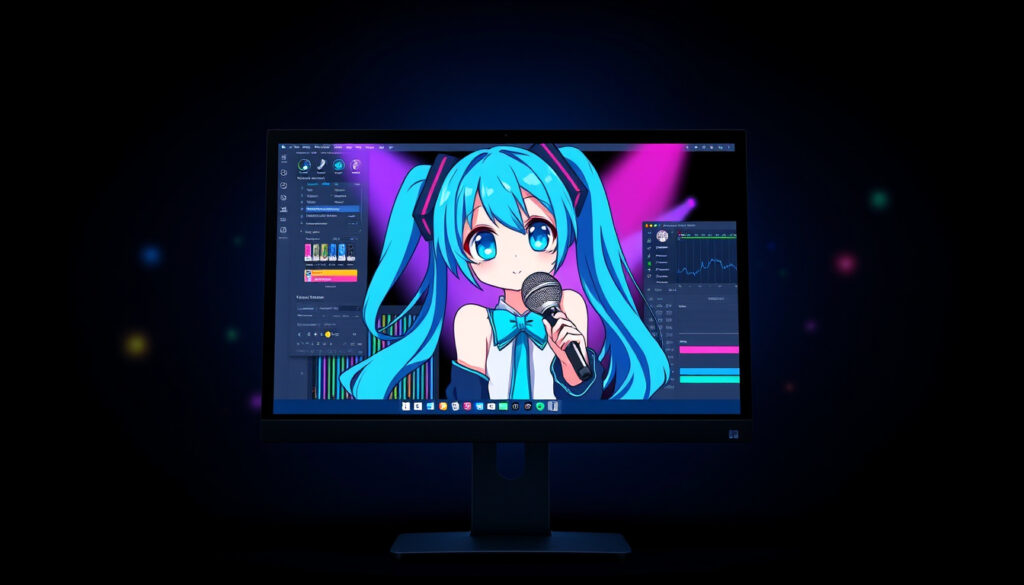
Hatsune Miku: Facts, Age, Anime Appearances
Few digital creations have crossed into real-world culture the way Hatsune Miku has. Since her debut on August 31, 2007, this turquoise-haired virtual singer has inspired over 100,000 songs, sold out concerts around the globe, and sparked a fan community that treats her less as software and more as an artist.
First released: August 31, 2007 ·
Developer: Crypton Future Media ·
Voice provider: Saki Fujita ·
Songs using her voice: Over 100,000 ·
Concert tours: Hatsune Miku EXPO worldwide ·
Meaning of name: The first sound from the future
Quick snapshot
- Hatsune Miku is a singing voice synthesizer software developed by Crypton Future Media (VOCALOID official history)
- Her voice is based on voice actress Saki Fujita (Voyapon)
- Over 100,000 songs have been created using her voice (VOCALOID official history)
- Whether Hatsune Miku has a defined sexual orientation
- The exact number of fan-made songs (estimated over 100,000)
- Future plans for Hatsune Miku EXPO locations
- Official confirmation of cameo appearances in ‘The iDOLM@STER’ and ‘Wreck-It Ralph’
- Whether ‘Hatsune Miku: Project DIVA’ and ‘Hatsune Miku: Live Party’ are official anime
- Whether Hatsune Miku is suitable for children ages 10+
- Whether Hatsune Miku is presented as pansexual in any official capacity
- Whether ‘World is Mine’ is her most famous song
- The exact start date of Hatsune Miku EXPO
- Whether Hatsune Miku was the first character in Crypton’s Character Vocal Series
- Whether “Hatsu” means first, “ne” means sound, and “Miku” can mean future
- Whether her age is based on her release date, not a biological age
- Whether some fan-made songs and videos may contain mature themes
- Whether parental guidance is recommended for user-generated content
- Released August 31, 2007 (VOCALOID history)
- First live concert in 2009 (Click Nippon)
- Continued EXPO tours and new software updates
- Growing use in fan-made music and video games
- Potential expansion into augmented reality concerts
Eight key facts capture the essential data behind the virtual singer.
| Attribute | Value |
|---|---|
| Full name | Hatsune Miku |
| Developer | Crypton Future Media (official history) |
| Voice provider | Saki Fujita (Voyapon) |
| Release date | August 31, 2007 |
| Age (2025) | 17 years |
| Height | 158 cm (5’2″) |
| Meaning of name | “The first sound from the future” (VOCALOID history) |
| Songs using her voice | Over 100,000 |
What is the story behind Hatsune Miku?
Who created Hatsune Miku?
- Hatsune Miku was created by Crypton Future Media for the VOCALOID2 engine (VOCALOID official history)
- Developer Sasaki Wataru is identified as the creator in an educational interview (Click Nippon (The Japan Forum))
- Her voice was sampled from voice actress Saki Fujita (Voyapon)
What does Hatsune Miku mean?
- The name translates to “the first sound from the future” (VOCALOID history)
- Fans also celebrate March 9 as “Miku Day” because 39 can be read as “mi-ku” in Japanese wordplay (Voyapon)
Hatsune Miku is not a person or a fictional character in the traditional sense — she is a software instrument that anyone can use to create music. The name embodies the ambition: the first sound of a new era of music production.
The story behind Miku is less a biography and more a product roadmap with a cultural twist. She began as a voice bank for the VOCALOID2 synthesizer, but user creativity turned her into a global icon. The implication: her identity is collectively written by thousands of fans, not just a corporate script.
In what anime is Hatsune Miku in?
Miku’s anime appearances are sporadic and often non-canon — she functions as a cameo or mascot rather than a recurring character. The pattern: her ubiquity in anime-style art is driven more by fan culture than by official production studios.
Is Hatsune Miku ok for kids?
Is Hatsune Miku appropriate for children?
- The Hatsune Miku software and most official content are rated for all ages (VOCALOID history)
Parents should treat Miku like any online creative platform: the tool itself is safe, but the content made with it varies. The official ecosystem is clean; the fan ecosystem is uncurated.
The safety question really depends on which Miku you encounter — the official product or the fan remix. The trade-off: broad creative freedom for children comes with the need for active supervision.
Does Miku support LGBTQ?
Miku’s lack of official orientation is a deliberate blank slate — fans project what they wish. The pattern: the character’s neutrality allows her to be inclusive without taking a political stance.
What are the most popular Hatsune Miku songs?
Miku’s song library is the ultimate proof of her instrument nature — she doesn’t “sing” anything until a human writes the melody and lyrics. The implication: her popularity is a measure of her users’ creativity, not her own artistry.
What is Hatsune Miku EXPO?
Hatsune Miku EXPO turns a software product into a live event that rivals tours by human musicians. The catch: the “performer” is entirely digital, but the audience experience is remarkably similar to a conventional concert.
What is Hatsune Miku’s birthday and age?
How old is Hatsune Miku?
- Hatsune Miku’s official birthday is August 31, 2007 (VOCALOID official history)
Miku’s age is a marketing artifact — she remains 16 in most official media, making her a permanent teen. The implication for fans: she never grows up, which keeps her eternally relatable to each new generation of users.
Hatsune Miku is simultaneously one of the youngest virtual idols (released in 2007) and one of the most enduring. Her age hasn’t changed, but her influence has only grown because creators keep renewing her relevance.
Timeline of key events
- August 31, 2007 — Hatsune Miku released as Vocaloid 2 software (VOCALOID history)
- 2009 — First live concert using holographic projection (Click Nippon)
From a single software release to a global touring phenomenon in seven years — Miku’s timeline shows how quickly a tool can become a cultural institution when the community takes ownership.
Quotes from the project
Hatsune Miku is described as software designed to make a computer sing songs, not a living person.
— Crypton Future Media description (via Blokees (third-party summary))
The name means ‘the first sound from the future’.
— VOCALOID official history (Yamaha)
Hatsune Miku EXPO is a worldwide concert tour featuring holographic performances.
These quotes reinforce Miku’s dual nature: she is a tool for music creation, yet she inspires the same devotion as a human artist. For fans and developers alike, the line between software and icon is deliberately blurred.
Hatsune Miku is not a person, a character, or a brand — she is a platform for musical creativity that grew beyond its original design. For anyone curious about virtual idols, the choice is clear: engage with the official software and official events, or dive into the vast, uncurated world of fan creations. Either path reveals why a singing synthesizer from 2007 still commands stages in 2025.
Related reading
- MF DOOM: The Life, Death, and Legacy of the Masked Rapper
- House of the Rising Sun: Origins, Versions, Lyrics & Chords
For a more detailed exploration of her career and song catalog, the virtual singer guide provides extensive information.
Frequently asked questions
What is Hatsune Miku?
Hatsune Miku is a singing voice synthesizer software developed by Crypton Future Media for the VOCALOID2 engine. She is also used as a digital mascot and virtual performer.
What does Hatsune Miku look like?
She is typically depicted as a 16-year-old girl with long turquoise twintails and a futuristic outfit.
Is Hatsune Miku a real person?
No, she is a virtual singer created from sampled voice recordings. She does not have a physical body or real human consciousness.
What are the best Hatsune Miku songs?
Popular fan favorites include ‘World is Mine’, ‘Senbonzakura’, and ‘Melt’. Over 100,000 songs have been created using her voice.
How can I see Hatsune Miku in concert?
Attend a Hatsune Miku EXPO tour event, which uses holographic projection. Check the official Crypton Future Media website for upcoming dates.
Does Hatsune Miku have a gender?
She is presented as female in official media, but as a software character she does not have a real gender. Some fans interpret her as genderless.
More related posts
 University of British Columbia: Ivy League Status & Facts
 When to Worry About Blood in Stool – Key Signs and When to Act
 170 lbs to kg: Conversion, BMI, and Health Insights
 Kyler Murray Injury, Trade, Height & Career Stats 2025
 How to Make Whipped Coffee (Dalgona) – Easy 3-Ingredient Recipe
 Who Won the Last World Cup? Argentina’s 2022 Victory
 Cast of Stand by Me (Film) – Complete Actors List and Roles
 Wings of Fire Graphic Novels: Counts, Age Ratings & Bans