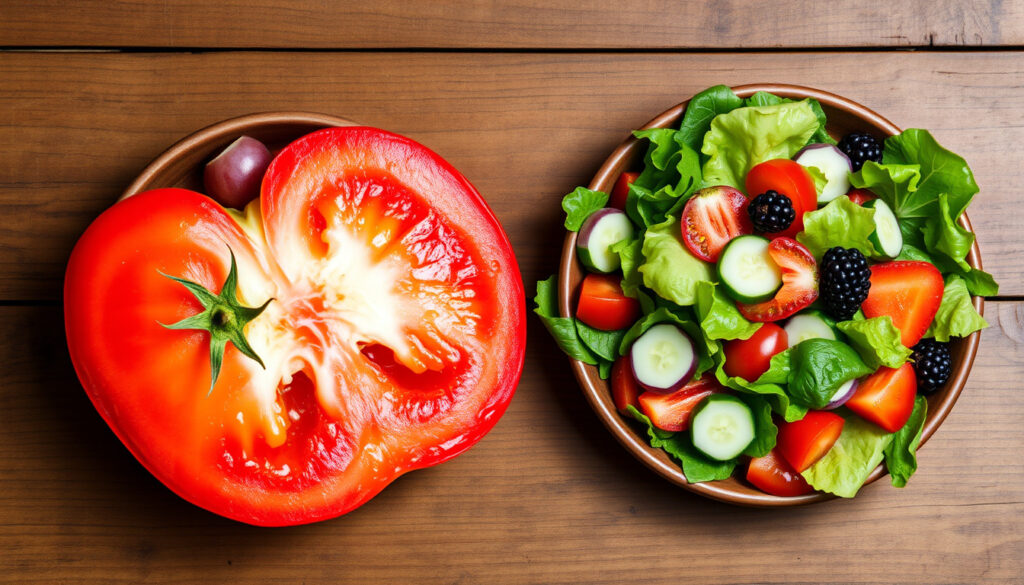
Is Tomato a Fruit – Botanists Say Yes, Cooks Say No
The question of whether a tomato qualifies as a fruit or vegetable has sparked debate among botanists, chefs, and legal scholars for generations. Botanically speaking, the answer is clear: tomatoes are fruits. However, culinary tradition and a landmark United States Supreme Court ruling have established them as vegetables in everyday usage.
This apparent contradiction stems from two distinct classification systems operating in parallel. One follows the scientific definition based on plant reproductive structures; the other reflects how people actually use these terms in kitchens, markets, and legislation. Understanding both perspectives reveals why this classification remains genuinely complicated.
The distinction carries real consequences. Food labeling, import tariffs, and nutritional guidelines all depend on how society categorizes tomatoes. The tension between botanical accuracy and common usage has shaped everything from grocery store shelving to international trade policy.
Is a Tomato a Fruit or a Vegetable?
Fruit
Develops from flower ovary
Vegetable
Used in savory dishes
Vegetable
Supreme Court, 1893
Fruit Benefits
Vitamins, lycopene
- Botanically, a tomato is a fruit because it develops from the ovary of a flowering plant and contains seeds
- The United States Supreme Court ruled in 1893 that tomatoes are legally vegetables for tariff purposes
- Justice Horace Gray’s opinion prioritized common parlance over botanical science
- The Court acknowledged tomatoes are “the fruit of a vine” botanically while classifying them as vegetables
- This ruling established the “Ordinary Meaning Rule” in statutory interpretation
- Culinary classification depends on flavor profile, sugar content, and how foods are prepared
- Both classifications have legitimate standing depending on the context
| Aspect | Botanical View | Culinary View |
|---|---|---|
| Definition | Mature ovary of a flowering plant containing seeds | Edible plant parts used in savory cooking |
| Tomato Classification | Fruit (berry) | Vegetable |
| Key Examples | Tomato, cucumber, avocado, pepper | Lettuce, carrot, potato, celery |
| Classification Basis | Plant reproductive structures | Flavor, preparation method, tradition |
What Defines a Fruit Botanically?
The Scientific Definition of a Fruit
Botanical science defines a fruit as the mature ovary of a flowering plant, typically containing seeds. This definition emerges from the plant’s reproductive biology: after pollination, the flower develops into a fruit that protects and disperses the seeds. By this standard, tomatoes unquestionably qualify as fruits. The Botanical Society of America explains that this classification system focuses entirely on plant physiology rather than human culinary preferences.
The tomato develops from the flower of the Solanum lycopersicum plant. As the ovary matures, it swells around the seeds, forming what botanists classify as a berry—a specific type of fruit. This development process mirrors other well-known fruits like grapes and blueberries, though tomatoes belong to the nightshade family rather than the vine families of these other berries.
Vegetables in Botanical Terms
Botanical science recognizes vegetables as edible plant parts that are not developed from flower ovaries. These include roots (carrots), stems (celery), leaves (lettuce), and tubers (potatoes). The botanical term “vegetable” has no formal scientific status; instead, botanists categorize edible plants by their specific anatomical structures. This creates a stark contrast with culinary classification, where vegetables typically refer to savory plant foods used in main courses rather than desserts.
Botanical classification is universal and consistent worldwide. Scientists across all disciplines agree that tomatoes are fruits based on their development from flower ovaries containing seeds.
The Supreme Court Ruling on Tomatoes
The Origins of Nix v. Hedden
The legal battle over tomato classification began with the Tariff Act of 1883, which imposed duties ranging from 10 to 25 percent on imported vegetables while exempting fruits from taxation entirely. John Nix, an importer of produce from the West Indies, believed tomatoes should enter the country tax-free as botanical fruits. New York customs collector Edward Hedden disagreed, classifying the tomatoes as vegetables subject to the tariff. This disagreement eventually reached the United States Supreme Court. The full case details are available through Justia.
The case numbers 149 U.S. 304, decided on May 10, 1893. Justice Horace Gray wrote the unanimous opinion that would reshape how courts interpret everyday words in legal contexts.
The Court’s Reasoning
Justice Gray’s decision acknowledged the botanical facts explicitly. The opinion states that “botanically speaking, tomatoes are the fruit of a vine, just as are cucumbers, squashes, beans, and peas.” However, the Court determined this scientific reality did not control the tariff law’s meaning. Gray argued that Tariff Acts use words “in their ordinary sense” and that ordinary Americans understood “fruit” and “vegetable” based on culinary usage rather than botanical definitions.
The Court examined how people actually used these terms. Witnesses confirmed that tomatoes appeared at dinner alongside other vegetables—in salads, soups, and savory dishes—rather than with fruits served as desserts. Dictionaries of the era supported this common understanding. The Court dismissed the botanical classification by noting that treating tomatoes as fruits would be “not unlike the suggestion that a bean or a pea is a seed rather than a vegetable.”
“These definitions have no tendency to show that tomatoes are ‘fruit,’ as distinguished from ‘vegetables’ in common speech.”
— Justice Horace Gray, Nix v. Hedden, 1893
Legal Precedent and the Ordinary Meaning Rule
The Nix v. Hedden decision established what scholars call the Ordinary Meaning Rule in statutory interpretation. This principle holds that courts should interpret words according to their common, everyday meanings unless words have acquired a specific technical meaning within a particular trade or profession. The ruling has influenced countless subsequent cases involving ambiguous statutory language.
The 1893 ruling affected food labeling, trade regulations, and taxation systems globally. Its influence extends far beyond tomatoes to any situation where legal definitions diverge from scientific classifications.
Other Foods That Are Botanically Fruits
Common Culinary Vegetables That Are Botanical Fruits
The tomato is far from alone in its dual classification. Several foods universally treated as vegetables in kitchens and markets are technically fruits by botanical definition. Britannica provides a comprehensive overview of how these classifications developed.
Cucumbers develop from cucumber flowers and contain seeds within their flesh, making them botanical fruits. The Supreme Court itself cited cucumbers as analogous to tomatoes in its ruling. Similarly, bell peppers grow from flowers and house seeds in their central cavity, classifying them as fruits despite their savory culinary role.
Eggplants develop from the eggplant flower’s ovary and contain small seeds when mature. Zucchini and other summer squashes follow the same pattern—immature fruits of squash plants, classified botanically as fruits but universally prepared as vegetables. Avocados present an interesting case: they are botanical fruits (specifically berries) but occupy ambiguous culinary territory, sometimes grouped with vegetables in salads and sometimes considered fruits for their fat content.
True Vegetables: Foods That Match Both Classifications
Not all culinary vegetables lack botanical fruit status. Some foods align with both classification systems. Potatoes provide a clear example: these tubers are underground stems that store energy for the plant. They are vegetables botanically, culinarily, and legally—a rare consistency across all three classification systems.
Leafy greens like lettuce and spinach develop from leaves rather than flower ovaries, making them vegetables in every sense. Root vegetables such as carrots and beets grow below ground as modified roots, while celery stalks are stems. These anatomical realities create no conflict between scientific and culinary classifications.
Understanding the Classification Confusion
The persistent confusion between botanical and culinary classifications reflects different purposes for categorization. Scientists classify based on plant reproductive biology to understand evolutionary relationships and plant development. Cooks classify based on flavor profiles, sugar content, and how ingredients behave in recipes. Courts classify based on how ordinary people understand words—which often reflects culinary rather than botanical reality.
This three-way split means a single food can legitimately hold different statuses depending on who is asking and why. The tomato exemplifies this perfectly: a fruit to botanists, a vegetable to chefs, and legally a vegetable for trade purposes following Nix v. Hedden. All three perspectives are correct within their respective contexts.
A Timeline of Tomato Classification
Understanding when and why tomato classification became contentious requires examining key moments in both scientific and legal history. For a deeper exploration of this topic, visit our complete guide to tomato classification.
- 17th-18th Century: Botanical science establishes that tomatoes develop from flower ovaries and contain seeds, formally classifying them as fruits within scientific literature.
- 1883: The Tariff Act introduces vegetable duties ranging from 10-25 percent while exempting fruits, creating financial stakes for tomato importers.
- 1887: Lower courts rule in favor of importer John Nix, accepting the botanical fruit argument to exempt tomatoes from vegetable tariffs.
- 1893 (May 10): The United States Supreme Court upholds the vegetable classification in Nix v. Hedden, establishing legal precedent that prioritizes common usage over botanical definitions.
- Post-1893: The ruling shapes food labeling regulations, trade policy, and continues influencing how courts interpret everyday language in legal statutes.
What Science Confirms and What Remains Unclear
| Established Facts | Areas of Ambiguity |
|---|---|
| Botanists universally classify tomatoes as fruits (berries) | Whether culinary classification should follow legal precedent or botanical science |
| Tomatoes develop from flower ovaries and contain seeds | How modern food labeling should balance scientific accuracy with consumer expectations |
| The Supreme Court ruled in favor of vegetable classification for tariff purposes | Whether imported scientific understanding should influence domestic legal interpretation |
| Justice Gray’s opinion prioritized “common parlance” over technical definitions | How nutrition guidelines should group tomatoes for dietary recommendations |
While botanical classification is scientifically settled, culinary and legal classifications continue evolving. No international standard resolves the tension between scientific precision and everyday usage.
The Broader Context: Science, Law, and Daily Life
The tomato classification debate illuminates fundamental tensions between different ways of knowing and categorizing the natural world. Scientific classification aims for precision based on observable biological characteristics. Legal classification seeks to reflect how ordinary people understand language in practical contexts. Culinary classification prioritizes flavor, texture, and how ingredients combine in recipes.
These different purposes explain why the same tomato can simultaneously be a fruit, a vegetable, and legally classified as a vegetable depending on context. No single authority resolves these competing frameworks because each serves distinct functions in different domains of human activity.
The practical implications extend beyond terminology. Import duties, nutritional guidance, school lunch programs, and agricultural subsidies all depend on classification systems that may follow different logics. Understanding that multiple valid perspectives exist helps navigate situations where these frameworks conflict. Learn more about botanical classifications and their everyday impact.
Expert Perspectives and Primary Sources
“Botanically speaking, tomatoes are the fruit of a vine, just as are cucumbers, squashes, beans, and peas.”
— United States Supreme Court, Nix v. Hedden, 149 U.S. 304 (1893)
“These definitions have no tendency to show that tomatoes are ‘fruit,’ as distinguished from ‘vegetables’ in common speech.”
— Justice Horace Gray, writing for the unanimous Court
Botanists maintain consistent classification: tomatoes are fruits because they develop from flower ovaries and contain seeds. The scientific community shows no divergence on this point. The debate exists entirely in how non-scientific contexts interpret and apply these terms.
The legal precedent established in Nix v. Hedden remains influential in statutory interpretation. Courts continue applying the Ordinary Meaning Rule when interpreting ambiguous language, often citing this tomato case as a foundational example of prioritizing common usage over technical definitions.
The Bottom Line on Tomato Classification
Botanically, a tomato is a fruit—specifically a berry that develops from the ovary of a flowering plant and contains seeds. This classification is definitive within botanical science and universally accepted among plant biologists.
However, culinary tradition and legal precedent have established the tomato as a vegetable in practical usage. The Supreme Court’s 1893 ruling in Nix v. Hedden prioritized common parlance over botanical definitions for tariff purposes, creating a legal classification that persists in food labeling and trade regulations today.
Both perspectives hold validity within their respective frameworks. The tomato’s dual nature reflects different human purposes for classification rather than any scientific uncertainty. Understanding this distinction allows appreciation for both botanical precision and the practical reasons why everyday language often diverges from scientific terminology.
Frequently Asked Questions
Does it matter if tomato is a fruit?
Yes, classification affects food labeling, import tariffs, and nutritional guidelines. Botanically, the answer is definitive—legally and culinarily, usage varies based on context.
Is a potato a fruit?
No. A potato is an edible underground stem called a tuber, making it a vegetable both botanically and culinarily without any conflicting classification.
Is an avocado a fruit?
Yes. Botanically, an avocado is a fruit—a single-seeded berry. Culinary usage varies between fruit and vegetable depending on preparation and context.
What other vegetables are actually fruits botanically?
Tomatoes, avocados, cucumbers, eggplants, peppers, and zucchini are all botanically fruits despite their culinary classification as vegetables.
What was Nix v. Hedden about?
The 1893 Supreme Court case ruled that for tariff purposes, tomatoes should be classified as vegetables based on common culinary usage rather than botanical definitions.
Is a cucumber a fruit?
Yes. Botanically, cucumbers are fruits—they develop from flowers and contain seeds. Culinary tradition classifies them as vegetables.
Why are tomatoes called vegetables in cooking?
Tomatoes are used in savory dishes alongside other vegetables, have lower sugar content compared to sweet fruits, and appear in salads, soups, and sauces rather than desserts.
More related posts
 Jerome Powell: DOJ Investigation, Salary, and Trump Feud
 Where Is Area Code 647 – Toronto and GTA Coverage Details
 Symptoms of Heart Attack – Warning Signs for Men and Women
 Russian Kotleti Near Me – Local Spots, Authentic Recipe Guide
 Kristen Bell: Biography, Children, Mental Health, Net Worth & More
 Benjamin Moore Revere Pewter HC-172: Guide to Greige
 Google Tic-Tac-Toe: How to Play, Grid Sizes, and Strategies
 Bear Attack Fort Steele – Elk Hunter Dies Weeks After Grizzly Attack