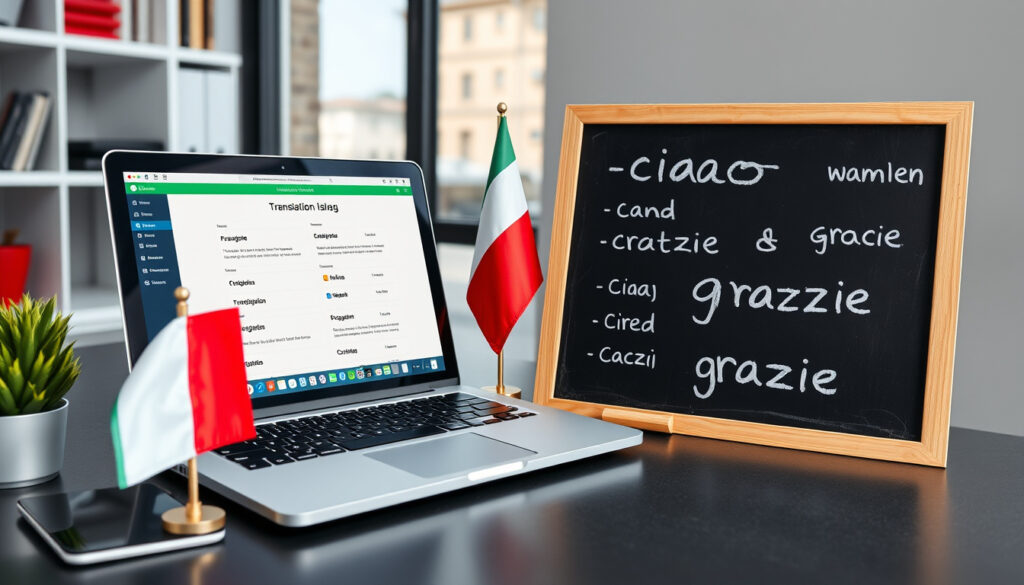
English to Italian Translator: Best Tools & Slang Guide
Anyone who’s tried turning an English phrase into natural Italian knows one wrong word can change the whole meaning. With dozens of translation tools online, picking the right one means weighing accuracy, language support, and how well they handle everyday slang. DeepL, for example, boasts an 89% accuracy rate for European languages, while Google Translate covers 133 languages and processes over a billion translations every day (UMEVO (language tech analysis)).
Languages supported by Google Translate: 133 ·
Languages supported by DeepL: 33 ·
Languages supported by Collins Dictionary: 30 ·
Daily translations processed by Google Translate: Over 1 billion ·
DeepL claims highest accuracy for European languages: Yes
Quick snapshot
- DeepL is accurate for European languages (UMEVO)
- Google Translate is free and widely used (Google Translate official site)
- Italian slang varies by region (Collins Dictionary (language reference))
- Which translator is best for translating Italian slang
- Real-world accuracy rankings beyond company claims
- Whether AI translation models can fully capture regional Italian dialects remains unclear
- 2026 AI translation models now recognize common idioms like “piece of cake” and translate to Italian “un gioco da ragazzi” (iFLYTEK (tech blog))
- Expect wider idiom support and improved cultural nuance handling in future updates from major providers (UMEVO)
Here are the key facts about the top English to Italian translators.
| Label | Value |
|---|---|
| Most accurate translator | DeepL (commonly cited) |
| Most languages | Google Translate (133) |
| Best for context | Reverso Context |
| Best for definitions | Collins Dictionary |
| Free voice translation | Google Translate |
What is the most accurate Italian to English translator?
For raw accuracy for European language pairs, DeepL repeatedly tops independent benchmarks. In a 2025 Intento study, DeepL achieved top performance in 65% of tested language pairs, especially across European languages (Taia (translation comparison)). Professional evaluators found DeepL produced roughly 10 translation errors compared to Google Translate’s 25 errors in side-by-side tests (Taia).
For users translating formal Italian documents or literature, DeepL’s lower error rate makes it the safer choice. But its limited language portfolio (33 languages) means you’ll need another tool for less common pairs.
How does DeepL compare to Google Translate?
DeepL achieves 91.5% accuracy for verb valency in Italian compared to Google Translate’s 57.4%, according to a 2025 analysis by UMEVO (UMEVO (language tech analysis)). However, Google Translate handles 133 languages and offers voice input, making it more versatile for travelers. 82% of language service providers trust DeepL for professional translation work (UMEVO).
The pattern: DeepL is the specialist for European languages, Google Translate is the generalist with broader reach. The trade-off: narrower language support vs unparalleled language breadth.
Is it hard for English speakers to learn Italian?
Italian shares Latin roots with English, so many words feel familiar. However, Italian grammar is more complex — nouns have genders, verbs conjugate for person and number, and you have to master the subjunctive mood. On the plus side, pronunciation is straightforward for English speakers because Italian is spelled phonetically (Collins Dictionary (language reference)).
How long does it take to learn Italian?
The U.S. Foreign Service Institute estimates that an English speaker needs about 600-750 hours of study to reach full professional fluency in Italian. That’s roughly 24-30 weeks of intensive classroom work (Collins Dictionary (language reference)). Regular practice with native content and translation tools can accelerate progress, especially for vocabulary building.
Italian’s complex verb system trips up many learners. A translator that handles verb valency well — like DeepL — can help beginners check their conjugation accuracy.
The implication: Italian is challenging but not impossible for English speakers. A good translator becomes a learning crutch, not just a crutch.
What is Italian slang for hottie?
Italian slang for “hottie” includes “fico” (masculine) and “bomba” (feminine), both widely used in casual conversation. Regional variations exist — in Rome, you might hear “stronzo” used playfully, but it’s risky as it literally means “jerk” (Reverso Context (contextual translation)).
What does “che cosa” mean in Italian slang?
“Che cosa” literally means “what thing”. It’s a common expression used in both formal and slang contexts. In informal speech, Italians often shorten it to “che” or “cosa” (Collins Dictionary).
What is the Italian slang word for shut up?
The direct slang equivalent is “stai zitto” (to a male) or “sta’ zitta” (to a female). For stronger force, “chiudi il becco” (shut your beak) is used playfully (Reverso Context).
Why do Italians say “andiamo”?
“Andiamo” means “let’s go”. It’s used as an exclamation to hurry someone up or to indicate departure. It’s one of the most common verbs in Italian slang (Collins Dictionary).
Why do Italians say “che cavolo”?
“Che cavolo” literally means “what cabbage”. It’s an exclamation of surprise or annoyance, similar to “what the heck” in English (Reverso Context).
Is “Ciao Bello” flirty?
Yes. “Ciao bello” (to a man) or “ciao bella” (to a woman) is a friendly and often flirty greeting. It’s used among friends and romantic interests (Reverso Context).
What is a very Italian thing to say?
“Mamma mia!” — an all-purpose exclamation of surprise, joy, or frustration. Also “che figata!” meaning “how cool!” (Collins Dictionary).
The catch: Slang is highly regional and context-sensitive. A general-purpose translator may miss these nuances. Reverso Context, by showing real-world examples, does a better job here.
How do you use an English to Italian translator effectively?
Getting accurate translations isn’t just about picking the right tool — it’s about using it smartly. Follow these steps for better results.
-
Choose the right tool for your need
For quick phrases, Google Translate works. For precise formal text, use DeepL. For slang and idioms, Reverso Context. For definitions, Collins Dictionary.
-
Check the context
Always read the translated sentence to confirm it makes sense in context. Italian sentence structure differs from English, and a literal translation can sound odd (Reverso Context).
-
Use voice input for conversation practice
Google Translate supports voice input for English and Italian. Speak a phrase and hear it back in the target language. This helps with pronunciation and listening comprehension (Google Translate official site).
-
Translate documents with DeepL or Google
DeepL allows you to upload Word and PDF files; Google Translate lets you paste text or upload documents. Both preserve formatting reasonably well (DeepL (translation service)).
-
Verify slang with Reverso Context
When you encounter an Italian slang term, search it on Reverso Context. It shows example sentences from real media, so you see how the word is actually used (Reverso Context).
Why this matters: Without context checking, even the best translator can produce comedy — or offense. Using multiple tools in combination gives you the best chance of getting Italian right.
Which English to Italian translator offers the best features?
There’s no one-size-fits-all answer. Here’s a feature comparison across the top contenders.
| Feature | DeepL | Google Translate | Collins Dictionary | Reverso Context |
|---|---|---|---|---|
| Languages supported | 33 | 133 | 30 | 15 (main) |
| Accuracy rating | 89% (European lang) | 7.9/10 | N/A (reference) | High for idioms |
| Voice input | No | Yes | No | No |
| Document upload | Yes | Yes | No | No |
| Slang / idiom handling | Moderate | Weak | Good (definitions) | Excellent |
| Pricing | Free & Pro | Free | Free | Free & Premium |
DeepL wins on accuracy for European languages but lacks voice input. Google Translate covers almost every language and has voice, but falls short on idiomatic Italian. Reverso Context is the specialist for slang but has limited coverage.
What are the best free English to Italian translator apps?
Google Translate is the top free app with voice, camera, and offline modes. DeepL offers a free tier with generous character limits. Reverso Context is free with contextual examples. Collins Dictionary is free but more a reference tool than a translator (DeepL, Google Translate, Collins Dictionary).
The pattern: For everyday use, Google Translate’s breadth is hard to beat. For professional or slang work, you’ll lean on niche tools.
Upsides
- DeepL’s high accuracy for Italian formal text
- Google Translate’s massive language support and free voice input
- Reverso Context’s superior slang and idiom coverage
- Collins Dictionary’s reliable definitions and examples
Downsides
- DeepL only supports 33 languages, no voice input
- Google Translate struggles with Italian slang and verb valency (57.4% accuracy)
- Reverso Context limited language coverage
- Collins Dictionary less useful for full sentence translation
Confirmed facts vs. what’s still unclear
Confirmed facts
- DeepL is accurate for European languages, including Italian (Taia)
- Google Translate is free, widely used, and supports 133 languages (UMEVO)
- Italian slang varies by region and context (Reverso Context)
What’s still unclear
- Which translator is truly best for translating Italian slang — independent head-to-head tests are lacking
- How real-world accuracy rankings hold up beyond self-reported numbers
- Whether AI translation models can fully capture regional Italian dialects remains unclear
These uncertainties mean that the best translator depends on the specific use case.
“DeepL is the world’s most accurate translator”
— DeepL website (DeepL)
“We translate over 1 billion words every day”
— Google Translate about page (Google Translate official site)
For Italian learners and professionals, the choice comes down to what matters most: if accuracy in formal Italian is paramount, DeepL is your tool. If you need breadth and free voice translation, Google Translate wins. For slang and authentic context, Reverso Context. The clear consequence: invest in learning how to combine these tools, and you’ll improve your Italian translation accuracy significantly.
Related reading: What Does 6-7 Mean? TikTok Teen Slang Explained
latitudeprime.com, transyncai.com, machinetranslation.com, timekettle.co, maestra.ai
Frequently asked questions
Is DeepL free for English to Italian translation?
Yes, DeepL offers a free version with a character limit per month (currently 500,000 characters). The Pro version unlocks unlimited translation and faster speeds (DeepL).
How accurate is Google Translate for Italian?
Google Translate scores 7.9 out of 10 overall accuracy, but its verb valency accuracy for Italian is only 57.4%, compared to DeepL’s 91.5% (UMEVO). Good for basic phrases, less reliable for complex sentences.
Can I use an English to Italian translator offline?
Google Translate supports offline translation for Italian on both iOS and Android after downloading the language pack. DeepL requires an internet connection (Google Translate official site).
What is the best translator for Italian slang?
Reverso Context is generally considered the best for slang and idioms because it shows real-world usage examples. DeepL and Google Translate are less reliable for informal language (Reverso Context).
How do I translate documents from English to Italian?
You can upload Word, PDF, or plain text files to DeepL (free for up to 5 documents of 10 MB each) or paste text into Google Translate and download the translation. Both preserve formatting reasonably (DeepL).
Does Collins Dictionary provide audio pronunciations?
Yes, Collins Dictionary offers audio pronunciation for headwords in both English and Italian, which is helpful for learners (Collins Dictionary).
Can Reverso Context help with idiomatic expressions?
Yes. Reverso Context’s strength is showing how words and phrases are used in real bilingual texts, covering idioms and colloquial expressions that literal translators often miss (Reverso Context).
More related posts
 Gift Daddy: What Dads Actually Want – Gift Rules & Ideas
 Sun Retreats Sherkston Shores: Fees, Ownership & Best Time
 House of the Rising Sun: Origins, Versions, Lyrics & Chords
 Kaiju No. 8 Season 2 – Release Dates, Episodes and Streaming Guide
 170 lbs to kg: Conversion, BMI, and Health Insights
 Canada Tourism Freeze Hits US Destinations: Down 35%
 1 Cup in mL: US 236.6 mL, Metric 250 mL Conversions
 Ayesha Khan Pakistani Actress: Biography, Death, and Confusion