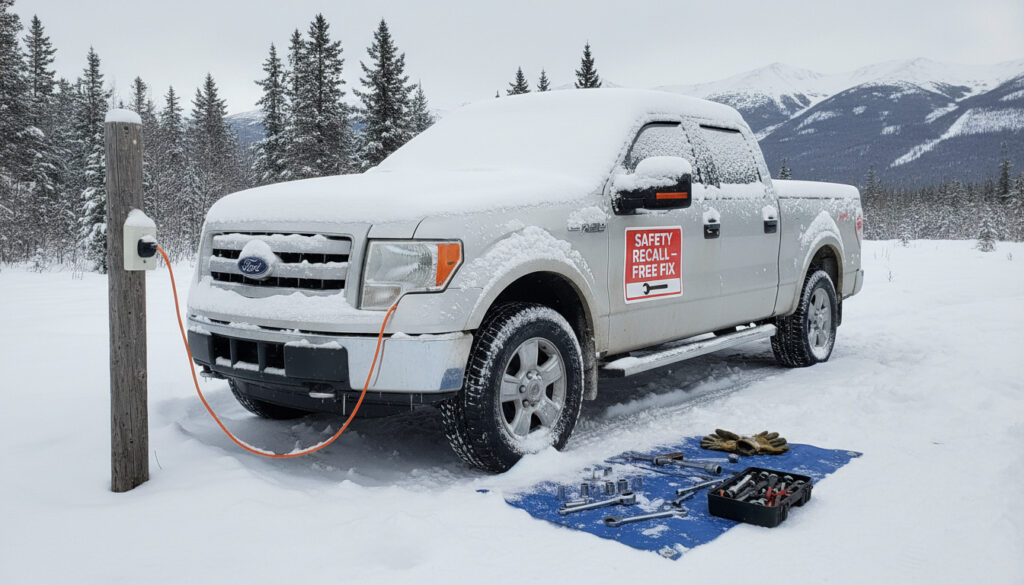
Ford Engine Block Heater Recall Canada – Affected Models, Risks & Free Fixes
Ford Motor Company has issued a sweeping safety recall affecting approximately 332,410 vehicles across Canada due to defective engine block heaters that pose a significant fire hazard. The recall, designated Transport Canada 23S17 and initially referenced as campaign 2025554, warns owners that coolant leaks from cracked heater elements can trigger electrical short circuits, resulting in melted cords and underhood fires when vehicles are plugged in.
Transport Canada and Ford have instructed affected vehicle owners to immediately discontinue use of their engine block heaters until repairs can be completed at authorized dealerships. The danger manifests exclusively when the block heater is connected to an electrical outlet, creating a latent risk during cold-weather parking.
The scope of this recall extends across multiple Ford and Lincoln model lines produced between 2013 and 2024, encompassing popular trucks, SUVs, and passenger cars. Replacement parts became available in early 2026, with dealerships now performing free installations of redesigned heater components.
What Is the Ford Engine Block Heater Recall in Canada?
Transport Canada 23S17 (2025554, superseded by 2026-005)
Approximately 332,410 Ford and Lincoln vehicles
Coolant leaks causing short circuits and underhood fires
Free replacement at authorized dealerships
- Massive Canadian Impact: Over 332,000 vehicles require immediate attention, making this one of Ford’s largest cold-weather component recalls in recent years.
- Fire Hazard Mechanism: Cracks in the heater element allow engine coolant to contact electrical components, creating resistive short circuits that can ignite surrounding materials.
- 46 Documented Fires: Ford has confirmed 46 fire incidents related to this defect, with the majority occurring in Canada where block heater usage is highest.
- Immediate Stop-Use Order: Unlike some recalls allowing continued operation until repair, this campaign mandates complete cessation of block heater use.
- Plug-In Risk Only: The fire hazard exists solely when the vehicle is parked and the block heater cord is connected to an electrical source.
- Cross-Border Coordination: Canada initiated the recall in October 2025, preceding the United States’ January 2026 action covering 119,000 vehicles.
- Parts Availability: Full replacement components became available in April 2026 after an interim period where owners had to wait without the heating function.
| Attribute | Details |
|---|---|
| Recall Number | Transport Canada 23S17 (2025554/2026-005) |
| Manufacturer | Ford Motor Company of Canada |
| Component | Engine Block Heater and Cord Assembly |
| Root Cause | Cracked heater element allowing coolant intrusion |
| Reported Fires | 46 incidents (predominantly in Canada) |
| Injuries | No confirmed injuries reported |
| Remedy | Complete replacement of block heater unit |
| Part Numbers | GJ7T-6A051-AA/B A (reference) |
| Notification Start | February 13, 2026 (interim letters) |
| Repair Availability | April 2026 |
Official Designations and Documentation
Transport Canada officially catalogued this safety campaign under multi-stage identifiers. The initial reference number 2025554 was later consolidated under 23S17 and subsequently updated to 2026-005 as the scope expanded to encompass over 332,000 units. Documentation from Transport Canada confirms the recall applies to both Ford and Lincoln branded vehicles equipped with optional or standard engine block heaters.
Which Ford Models and Years Are Affected?
The primary recall campaign targets a diverse range of Ford and Lincoln vehicles manufactured between 2013 and 2024. The affected population includes utility vehicles, trucks, and passenger cars that were factory-equipped with engine block heaters for cold-climate operation.
Primary Affected Models (2021-2024)
The bulk of the 332,410 recalled vehicles encompasses recent production models. These include the 2021-2024 Ford Bronco and Bronco Sport, the 2022-2024 Ford Maverick compact truck, and the 2019-2024 Ford Ranger. Lincoln’s contribution to the recall includes the 2020-2022 Corsair and 2015-2019 MKC crossovers. Vehicle identification records indicate these models carry the specific heater design prone to coolant intrusion.
Extended Production Runs (2013-2022)
Longer production spans increase the affected population significantly. The 2013-2022 Ford Escape, 2016-2024 Ford Explorer, and 2013-2018 Ford Focus represent high-volume nameplates with substantial Canadian market presence. Owners of these vehicles should verify their specific build dates, as not all units within these ranges necessarily included the factory block heater option.
F-150, Super Duty, and Expedition Considerations
While the primary 23S17 campaign specifically lists the models above, certain 2023-2024 Ford F-150, F-250 Super Duty, and Expedition vehicles may fall under separate but related campaigns if factory-equipped with block heaters. Earlier safety actions, specifically campaigns 18S45 (2018) and 19S11 (2019), addressed similar block heater cord corrosion and melting risks in 2015-2019 F-150 and 2017-2019 F-250/F-350 Super Duty trucks. NHTSA documentation and Transport Canada records confirm these prior actions targeted distinct but related component failures.
Do not assume your vehicle is safe based on model year alone. Ford produced multiple variants of block heaters across different supplier contracts. Verification through the official VIN lookup tool is the only reliable method to confirm exclusion from this recall.
What Are the Risks of the Faulty Engine Block Heater?
The Failure Mechanism
The defect originates within the engine block heater element itself. Over time, thermal cycling and material stress create cracks in the heater’s housing. These breaches allow engine coolant to leak directly onto the electrical connections and heating element. When the vehicle is plugged into an external power source, this coolant—containing conductive ionic compounds—creates a resistive short circuit. The resulting electrical arcing generates sufficient heat to melt the block heater cord and potentially ignite surrounding underhood components or the vehicle’s exterior.
Documented Incident Profile
Ford has acknowledged 46 fire incidents connected to this specific defect, with the geographic distribution heavily skewed toward Canada due to higher block heater utilization rates in cold climates. The fires typically occur during overnight parking when vehicles are left plugged in for extended periods. Notably, the risk exists exclusively during external power connection; unconnected vehicles carry no fire hazard from this defect. Legal documentation confirms that incidents occurred predominantly in residential settings without GFCI-protected outlets.
While GFCI outlets can reduce electrocution risks, they do not prevent the resistive heating and arcing caused by coolant-contaminated block heater elements. The short circuit occurs within the heater assembly itself, not the wall outlet.
How Do I Check If My Vehicle Is Affected and What to Do Next?
Verification Through Official Channels
Owners must utilize the Transport Canada recall database available at recalls-rappels.canada.ca or Ford’s proprietary owner portal to determine their vehicle’s status. Entering the 17-digit Vehicle Identification Number (VIN) will confirm whether the unit falls under campaign 23S17/2025554 or prior related actions such as 19S11. The official Transport Canada listing provides the definitive reference for VIN verification.
Immediate Cessation of Use
Upon confirmation of affected status—or if uncertainty exists—owners must immediately stop using the engine block heater. This means disconnecting the cord from both the vehicle and the electrical outlet, and refraining from plugging in the vehicle until the repair is completed. Given Canadian winter temperatures, this creates operational hardships, but the fire risk outweighs cold-start concerns.
Scheduling the Remedy
Ford dealerships will replace the entire engine block heater and cord assembly free of charge once parts are available. As of April 2026, replacement components including part numbers GJ7T-6A051-AA/B A are in distribution. Owners should contact their preferred Ford Canada dealership to schedule service, though wait times may vary based on regional parts availability and service bay capacity.
No interim repair or temporary fix exists for this defect. Ford has not authorized the use of aftermarket block heaters as replacements. Owners must wait for the official Ford replacement part to ensure safety and warranty compliance.
When Was the Recall Announced and What’s the Latest Status?
-
Transport Canada launches initial recall campaign 2025554 addressing block heater leaks in specific Ford models. Initial documentation establishes the scope of the coolant leak risk.
-
Prior recalls (18S45/2019174 and 19S11) address related block heater cord corrosion and melting in 2015-2019 F-150 and Super Duty trucks. Ford’s 2018 announcement and NHTSA 2018 documentation confirm these earlier actions.
-
Transport Canada expands the recall to encompass 332,410 vehicles across two coordinated campaigns, formally notifying owners to cease block heater use immediately.
-
The United States National Highway Traffic Safety Administration issues recall 26V012000 covering 119,000 vehicles, following Canada’s lead. CBS News reporting confirms the U.S. regulatory action.
-
Interim owner notification letters mailed to U.S. and Canadian addresses, advising of the defect and pending remedy.
-
Final replacement parts become available; dealerships begin performing full block heater replacements rather than interim inspections.
What Information Is Definitive and What Remains Unclear?
Established Facts
- Recall affects exactly 332,410 Canadian vehicles
- 46 fires confirmed by Ford
- Root cause identified as cracked heater elements
- Remedy involves complete component replacement
- Free repair policy confirmed for all affected owners
- Risk exists only when plugged into power sources
Unconfirmed Details
- Specific production batch failure rates
- Whether all 2023-2024 F-150/Super Duty trucks are affected
- Completion rates for repairs as of mid-2026
- Long-term durability data for replacement parts
- Precise geographic distribution of the 46 fires
Why Do These Recalls Affect Canadian Drivers Differently?
Engine block heaters serve as essential equipment in Canadian automotive culture, with installation rates far exceeding those in milder climates. These devices preheat engine coolant to facilitate cold-weather starting and reduce engine wear during sub-zero startups. The high utilization rates in Canada—where vehicles may remain plugged in for 12-16 hours overnight—create accelerated thermal cycling that stresses heater elements. This usage pattern explains why the majority of the 46 documented fires occurred in Canada despite the global distribution of affected vehicles.
The Canadian regulatory environment also differs from the U.S. approach. Transport Canada initiated the recall expansion in January 2026, coordinating closely with Ford’s North American engineering teams. For Canadian consumers seeking information on other product recalls and safety campaigns, resources like Hot Tub Covers Canada – Best Picks, Prices and Buyer’s Guide demonstrate the breadth of consumer safety oversight in the Canadian market.
Historical context shows Ford has addressed similar block heater issues previously, as seen in the 2018-2019 campaigns targeting F-150 and Super Duty cord corrosion. These recurring issues highlight the engineering challenges of creating reliable heating elements that withstand Canadian winter extremes while maintaining electrical isolation from engine fluids.
What Have Officials Said About the Safety Campaign?
“Owners are instructed to stop using the block heaters immediately until free replacement at Ford dealerships.”
— Transport Canada Recall Notice 2025554
“Cracks in the heater element allow coolant leaks onto electrical components, causing resistive short circuits, cord melting, and fires.”
— Ford Technical Service Bulletin Documentation
“Risk occurs only when plugged in and parked.”
— Transport Canada Safety Advisory
What Are the Key Takeaways for Vehicle Owners?
Canadian Ford and Lincoln owners must verify their VIN against the Transport Canada database immediately to determine if their vehicle falls within the 332,410-unit recall. If affected, discontinue block heater use completely until scheduling a free replacement at an authorized dealership. While the loss of cold-weather preheating capability creates inconvenience, the documented fire risk—46 confirmed incidents—demands strict adherence to the stop-use order. For those monitoring cross-border regulatory differences or financial implications of vehicle ownership, 100 US to CAD – Live Exchange Rate and Converter Today provides current currency data relevant to international automotive transactions.
Frequently Asked Questions
Is there a specific Ford F-150 engine block heater recall in Canada?
The 23S17 campaign primarily targets other models, but 2023-2024 F-150s may be affected if factory-equipped. Earlier recalls (18S45/19S11) specifically addressed 2015-2019 F-150 block heaters. Check your VIN to confirm your truck’s status.
Can the Ford block heater cord cause a fire without the heater being plugged in?
No. Transport Canada confirms the fire risk exists exclusively when the block heater is connected to an electrical outlet. Unconnected vehicles carry no fire hazard from this specific defect, though coolant leaks may still occur.
How do I get a free replacement for the Ford block heater recall in Canada?
Contact any authorized Ford Canada dealership with your VIN. The remedy involves free replacement of the entire block heater assembly. Parts became available in April 2026; simply schedule an appointment for the repair.
What is the exact recall number for the Ford block heater issue?
Transport Canada designates this as recall 23S17, initially referenced as 2025554 and later updated to 2026-005. U.S. owners should reference NHTSA campaign 26V012000.
Which years of Ford Super Duty trucks are included in the block heater recall?
The current 23S17 campaign does not primarily target Super Duty trucks. However, 2017-2019 F-250 and F-350 models were subject to earlier recalls (18S45/19S11) for cord corrosion. Some 2023-2024 Super Duty trucks may be affected if equipped with specific factory heaters.
What is the current status of the Ford block heater recall in Canada for 2024?
As of early 2026, the recall is active with full remedy availability. Replacement parts are in distribution at Ford dealerships. Owners should stop using block heaters immediately and schedule free repairs if they have not already done so.
More related posts
 Paris Hilton: ADHD Diagnosis, $300M Net Worth & DUI
 CPP and OAS Payment October 2025: Dates, Amounts & Increases
 Movies Out Right Now: Top 10 New Releases & Showtimes (2026)
 Milwaukee Bucks vs Chicago Bulls Match Player Stats – 2024 Series Breakdown
 Graham Norton: Private Life, Husband, Children, Net Worth & More
 1 Cup in mL: US 236.6 mL, Metric 250 mL Conversions
 1 CAD to INR Exchange Rate: 68.84 INR & Forecast 2026
 Symptoms of Vitamin D Deficiency: 10 Signs to Watch